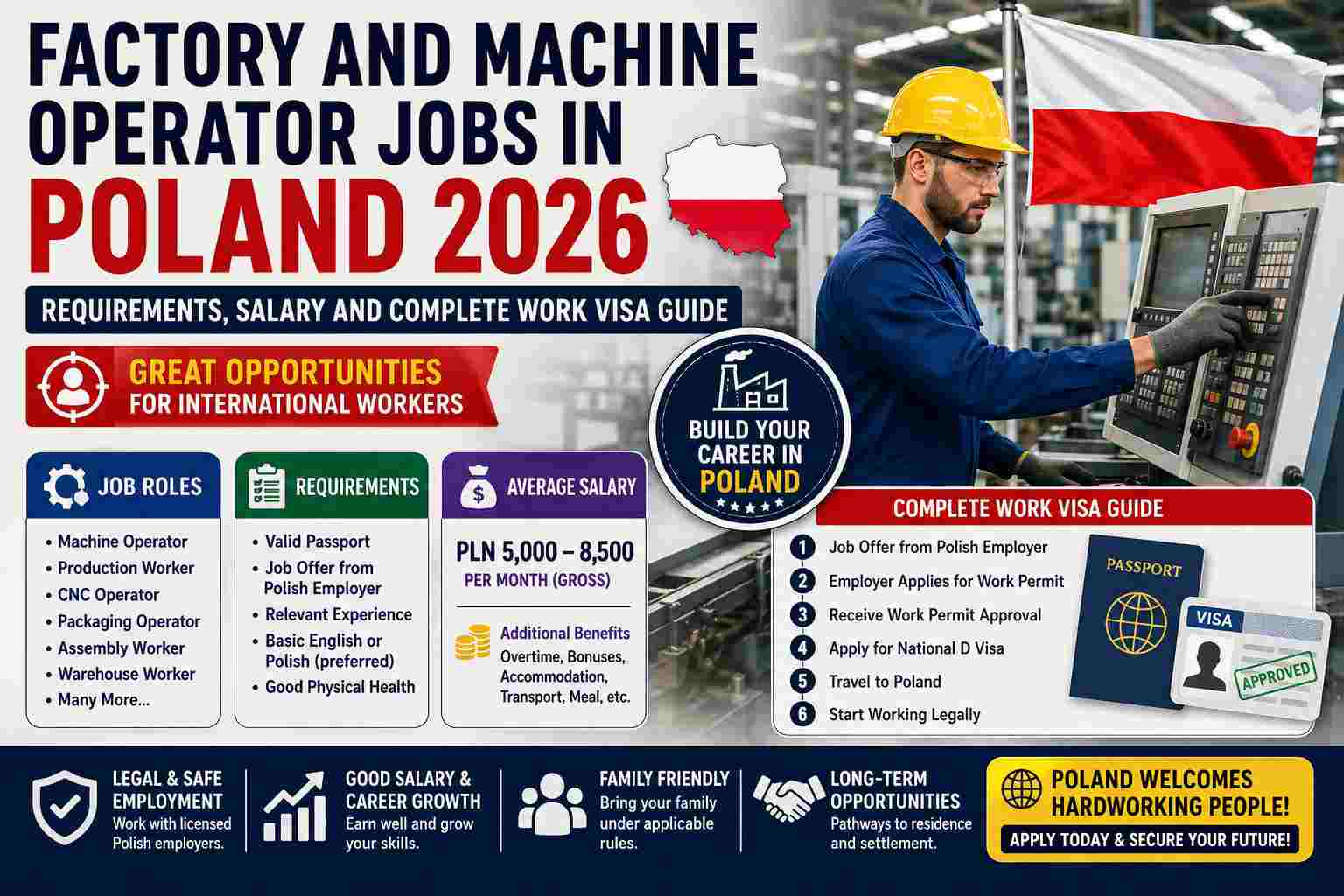
Poland remains an important manufacturing hub in Central Europe, creating opportunities for workers in factories, warehouses, food processing, automotive production, electronics, logistics and industrial manufacturing.
For international workers, factory worker and machine operator positions can be an accessible route into the Polish labour market, particularly when an employer is willing to complete the required work-permit formalities.
However, applicants should understand that Poland does not offer a single “factory worker visa.” In most cases, a non-EU worker needs a legitimate job offer, the appropriate work authorization and, where required, a Polish national work visa or residence permit.
Polish employment rules also changed significantly in 2025, with the new foreign-worker employment law coming into force on June 1, 2025 and important implementing changes taking effect on December 1, 2025.
Read More:
£75,000 UK Government Grants With Visa Sponsorship Jobs for International Workers
Top 15 Hospitals USA for Cancer: Leading Cancer Centers for Advanced Treatment
What Factory and Machine Operators Do in Poland
Factory and machine operator jobs cover a wide range of manufacturing activities.
Depending on the employer, workers may be responsible for:
- Operating production machinery
- Loading and unloading materials
- Monitoring production lines
- Packaging finished products
- Inspecting products for defects
- Setting or adjusting machines
- Maintaining production records
- Following workplace safety procedures
- Performing basic machine maintenance
- Sorting and preparing materials
- Working rotating shifts
- Meeting production targets
Machine operators with technical experience can generally target more specialized positions than entry-level production workers.
Popular Factory Jobs for Foreign Workers
International applicants may encounter vacancies such as:
Production Worker
Production workers assist with assembly, packaging, sorting and other manufacturing tasks.
These jobs can have relatively straightforward entry requirements, although employers may require physical fitness, shift availability and previous factory experience.
Machine Operator
Machine operators control production equipment and monitor machines during manufacturing.
Employers may prefer candidates with previous industrial experience or technical training.
CNC Machine Operator
CNC operators work with computer-controlled machinery and may be responsible for machine setup, tool changes, measurements and quality checks.
Experience reading technical drawings can be particularly valuable.
Packaging Machine Operator
Packaging operators work with automated or semi-automated equipment used to package food, consumer goods, pharmaceutical products and other products.
Food Production Worker
Food factories employ workers in processing, preparation, packaging and quality-control roles.
Depending on the position, workers may need additional medical or food-handling requirements.
Automotive Production Worker
Poland has a significant automotive manufacturing and component-supply industry, creating opportunities in assembly, production, quality inspection and machine operation.
Warehouse and Production Operator
Some employers combine warehouse and manufacturing responsibilities, requiring workers to move materials, operate equipment and support production lines.
Poland’s Minimum Wage in 2026
The statutory minimum wage is an important reference point when evaluating a Polish employment offer.
From January 1, 2026, Poland’s minimum monthly wage is PLN 4,806. The statutory minimum hourly rate for certain civil-law contracts is PLN 31.40 per hour. (Gov.pl)
These figures are national minimums and are not specific to factory workers.
Actual factory and machine-operator salaries can be higher depending on:
- Experience
- Job specialization
- Industry
- Location
- Shift work
- Overtime
- Employer
- Technical qualifications
- Bonuses
- Employment contract
Applicants should always determine whether an advertised amount is gross or net.
How Much Can Factory Workers Earn?
There is no single nationwide salary for a factory worker.
Entry-level production jobs may be closer to the statutory minimum, while experienced machine operators, CNC operators and specialized industrial workers can earn considerably more.
A typical employment package may include:
- Basic monthly salary
- Shift allowance
- Attendance bonus
- Productivity bonus
- Overtime pay
- Night-work allowance
- Accommodation assistance
- Transport to the workplace
- Meal benefits
However, benefits vary substantially between employers.
A job advertisement promising an unusually high “net” salary should be checked carefully. Applicants should ask the employer for the gross salary, normal working hours, overtime rate, accommodation deductions and expected take-home pay.
Gross Salary vs Net Salary
This is one of the most important points for international workers.
A Polish job advertisement might show a salary such as:
PLN 6,000 gross per month
This does not mean the employee receives PLN 6,000 in their bank account.
Taxes and social-security contributions can affect the final amount.
Similarly, an advertisement stating:
PLN 6,000–8,000 net
should be examined carefully to determine whether the figure depends on overtime, bonuses or other conditions.
Before accepting a job, ask the employer for a written breakdown of:
- Gross basic salary
- Expected net salary
- Working hours
- Overtime
- Shift allowances
- Bonuses
- Accommodation charges
- Transportation charges
- Other deductions
Requirements for Factory Jobs in Poland
Requirements depend on the occupation and employer.
For basic production jobs, employers may ask for:
- Valid passport
- Job offer or employment contract
- Ability to work shifts
- Physical fitness
- Basic communication skills
- Previous factory experience, where required
- Ability to follow safety instructions
For machine operator positions, employers may additionally request:
- Previous machine-operation experience
- Technical training
- Ability to read technical instructions
- Basic knowledge of machinery
- Quality-control experience
- Experience with production systems
For CNC and other specialized machinery, employers may require considerably more technical experience.
Is Polish Language Required?
Not every factory job requires Polish fluency.
Some international factories provide instructions in English or employ multilingual supervisors. Recruitment agencies may also assist workers who do not speak Polish.
Nevertheless, learning basic Polish can be a significant advantage.
Useful workplace vocabulary can help workers understand:
- Safety instructions
- Machine controls
- Emergency procedures
- Work schedules
- Supervisor instructions
- Production terminology
Applicants should never assume that “no Polish required” means “no communication skills required.” Workers must be able to understand safety and operational instructions.
Can Foreigners Get Factory Jobs in Poland?
Yes.
Foreign nationals can work legally in Poland when they have the appropriate right to work or fall under an exemption.
For a typical non-EU worker who does not already have free access to the Polish labour market, the employer may need to obtain a work permit before the worker begins employment. Poland’s official guidance explains that a work permit for a foreigner employed by a Polish entity is submitted electronically through praca.gov.pl. (Cudzoziemcy)
The worker then uses the appropriate documentation to obtain permission to enter and work in Poland, where a visa is required.
Poland Work Permit: How It Works
The work-permit process is primarily the employer’s responsibility.
A simplified process looks like this:
Step 1: Find a genuine Polish employer.
Step 2: Receive a formal job offer.
Step 3: The employer applies for the appropriate work permit.
Step 4: The work permit is issued if the legal requirements are satisfied.
Step 5: The worker applies for the appropriate Polish visa if one is required.
Step 6: The worker enters Poland legally.
Step 7: Employment begins according to the conditions authorized by the relevant documents.
A standard work permit for a foreigner working for a Polish entity currently has a fee of PLN 400, or PLN 200 for work for up to three months. The employer submits the application electronically. (Cudzoziemcy)
Poland National D Visa for Work
Workers who need a visa to enter Poland for employment commonly use a D-type national visa.
The Polish Office for Foreigners states that a person applying for a work visa generally needs a work permit unless the work-permit requirement has been waived. The future employer normally obtains the work permit. (Gov.pl)
The visa application is submitted through the appropriate Polish consular authority.
Applicants may need documents including:
- Valid passport
- Visa application
- Photograph
- Work permit
- Evidence of the purpose and conditions of stay
- Proof of sufficient financial resources where applicable
- Required health or travel insurance
- Other documents requested by the consulate
The exact procedure can vary by country of residence.
Poland Work Visa Fee
The standard national visa fee is currently €135, according to Poland’s official information on national visa fees. The fee can be subject to applicable exemptions and consular arrangements. (Cudzoziemcy)
Applicants should verify the amount and payment procedure with the Polish consulate or visa application system responsible for their country.
Important 2026 Rule: The Employer Must Handle the Work Permit
One of the biggest mistakes applicants make is believing they can independently purchase a Polish work permit.
In the normal employer-sponsored process, the employer submits the work-permit application.
Official Polish guidance confirms that the work-permit application is submitted electronically through the relevant employment portal. (Cudzoziemcy)
Therefore, be suspicious of anyone claiming:
“Send me money and I will sell you a Polish work permit.”
A legitimate recruitment process should identify the actual employer, position, salary and employment conditions.
Important Changes Since December 2025
Poland introduced important changes to the rules governing employment of foreigners.
The new legislation and implementing regulations changed the procedures for work permits and declarations and introduced updated documentation requirements. (migrant.poznan.uw.gov.pl)
One particularly important change concerns the declaration procedure.
Since December 1, 2025, the simplified declaration route applies to citizens of:
- Armenia
- Belarus
- Moldova
- Ukraine
Georgia is no longer included for new declarations under this procedure. Existing declarations registered before the change could continue under their existing validity periods. (Gov.pl)
This matters because applicants should not assume that a simplified route available to one nationality is automatically available to everyone.
What Is the Declaration Procedure?
The declaration on entrusting work to a foreigner is an alternative employment procedure available in specified circumstances and for eligible nationalities.
The employer submits the declaration rather than the worker.
Under the current rules, the declaration can cover employment for up to 24 months, and the employer must submit it before the foreign national starts work. (Cudzoziemcy)
The declaration procedure is therefore not a universal replacement for a work permit.
For many non-EU workers, particularly those whose nationality does not qualify for the declaration route, a regular work permit may be necessary.
Temporary Residence and Work Permit
A worker who is already legally in Poland may, depending on their circumstances, apply for a temporary residence and work permit.
Polish official guidance states that the remuneration specified for such a permit must generally be at least the statutory minimum wage. For 2026, this means at least PLN 4,806 per month. (Cudzoziemcy)
The temporary residence and work permit can provide a longer-term immigration option than relying solely on a visa, but eligibility depends on the worker’s circumstances and legal status.
What About the EU Blue Card?
The EU Blue Card is generally intended for highly qualified employment, so it is usually not the normal immigration route for an ordinary factory worker or entry-level machine operator.
For 2026 applications in Poland, the Blue Card salary requirement is significantly higher than the ordinary minimum wage: the official Polish guidance lists an annual gross remuneration threshold of PLN 160,264.08, equivalent to more than PLN 13,355.34 per month. (Cudzoziemcy)
Therefore, a normal factory-worker position would generally be pursued through ordinary work authorization rather than the Blue Card.
Factory Jobs and Seasonal Work
Some manufacturing-related jobs may be confused with seasonal employment.
Seasonal work has its own rules and permits, and not every factory position qualifies as seasonal work.
Applicants should therefore confirm the exact occupation and legal basis of employment rather than assuming that any short-term factory job can use a seasonal permit.
Documents International Applicants Should Prepare
Before applying for a factory position, it is useful to prepare:
- Passport
- Updated CV
- Employment history
- Training certificates
- Machine-operation certificates, if applicable
- Driving or forklift qualifications, if relevant
- Educational certificates
- Passport photographs
- Police or other documents if specifically required
- Proof of accommodation or other supporting documents when required
- Medical documentation where requested
Do not send original documents to an unknown recruiter.
How to Find Genuine Factory Jobs in Poland
International applicants can search through:
- Polish employer career pages
- Poland’s official employment services
- Established recruitment agencies
- European employment networks
- International job platforms
- Direct applications to manufacturing companies
Useful search phrases include:
“production worker Poland”
“machine operator Poland”
“CNC operator Poland”
“factory worker Poland visa sponsorship”
“production jobs Poland for foreigners”
“Poland work permit jobs”
“warehouse and production worker Poland”
However, the phrase “visa sponsorship” is sometimes used loosely by recruitment websites. Always confirm whether the employer actually handles the work authorization process.
How to Spot a Fake Poland Job Offer
Unfortunately, foreign workers are frequently targeted by fraudulent recruitment schemes.
Be cautious if a recruiter:
- Guarantees a visa
- Guarantees a specific salary without an interview
- Demands a large “work permit fee”
- Refuses to identify the employer
- Sends an unofficial contract
- Requests money before providing basic job details
- Promises permanent residence immediately
- Asks you to travel on a tourist visa to start factory work
- Refuses to explain accommodation deductions
- Uses only WhatsApp or social media and has no verifiable company information
A legitimate job should have identifiable employment conditions and a genuine employer.
Can You Work in Poland on a Tourist Visa?
A tourist visa should not be treated as a substitute for employment authorization.
Foreigners need the appropriate legal basis to perform work in Poland. Official guidance lists circumstances in which work can be performed without a work permit, but these are specific exceptions—not a general tourist-work rule. (Cudzoziemcy)
Never accept advice telling you to enter Poland as a tourist and start working illegally while “the papers are being processed.”
Accommodation for Factory Workers
Some Polish factories and recruitment agencies offer accommodation.
The arrangement may be:
- Free accommodation
- Subsidized accommodation
- Employer-provided accommodation deducted from wages
- Shared worker housing
- Private accommodation arranged by the worker
Before signing a contract, ask:
Is accommodation free?
If not, how much is deducted each month?
How many people share a room?
How far is the accommodation from the factory?
Is transportation provided?
These details can make a major difference to the worker’s actual monthly savings.
Working Hours and Shifts
Factory work frequently involves shift systems.
Possible schedules include:
- Morning shift
- Afternoon shift
- Night shift
- Rotating shifts
- Weekend shifts
The contract should clearly explain working hours and applicable overtime or shift arrangements.
Polish law provides statutory minimum pay protections, and the 2026 minimum hourly rate for certain civil-law contracts is PLN 31.40. (Gov.pl)
Workers should not assume that every hour worked beyond the ordinary schedule is already included in the advertised basic salary.
Is Factory Work in Poland Good for International Workers?
It can be, particularly for workers who:
- Have manufacturing experience
- Are willing to work shifts
- Have technical skills
- Want European work experience
- Have realistic salary expectations
- Choose a legitimate employer
- Understand the visa and work-permit requirements
Machine operators with specialized experience may have better prospects than completely inexperienced applicants.
CNC, industrial automation, maintenance and technical production experience can make a candidate more competitive.
Poland Factory Jobs: A Practical 2026 Checklist
Before accepting an offer, verify all of the following:
| Item | What to Check |
|---|---|
| Employer | Full legal company name and location |
| Position | Exact job title and duties |
| Salary | Gross and expected net amount |
| Contract | Type and duration |
| Hours | Normal weekly/monthly hours |
| Overtime | Rate and conditions |
| Shifts | Day/night/rotating schedule |
| Accommodation | Cost and deductions |
| Transport | Whether transport is provided |
| Work permit | Who submits it |
| Visa | Correct Polish visa category |
| Insurance | Required coverage |
| Recruitment fee | What you are legally required to pay |
| Start date | Only after authorization is in place |
Frequently Asked Questions
Can foreigners get factory jobs in Poland in 2026?
Yes. Non-EU foreigners can work legally in Poland when they have the required work authorization or qualify for an exemption.
How much does a factory worker earn in Poland?
There is no single national factory-worker salary. The statutory minimum monthly wage is PLN 4,806 in 2026, while actual factory and machine-operator salaries can be higher depending on experience, specialization, shifts and employer. (Gov.pl)
What is the minimum hourly rate in Poland in 2026?
The statutory minimum hourly rate for certain civil-law contracts is PLN 31.40 per hour from January 1, 2026. (Gov.pl)
Does a Polish employer have to obtain my work permit?
Where a work permit is required, the employer generally submits the application. The Polish system provides for electronic submission through praca.gov.pl. (Cudzoziemcy)
Can Indians apply for factory jobs in Poland?
Indian citizens can potentially work in Poland if they obtain the appropriate employment authorization and visa/residence status. They generally cannot use the simplified declaration route that is currently limited to citizens of Armenia, Belarus, Moldova and Ukraine. (Gov.pl)
Is Polish language mandatory?
Not for every factory job. Some employers recruit workers without Polish-language skills, but the ability to understand workplace and safety instructions remains important.
Can I bring my family to Poland?
Depending on your residence status and circumstances, family reunification may be possible. The rules depend on the type of permit and the family member’s situation, so this should be checked separately.
Can factory work lead to permanent residence?
Potentially, but employment alone does not automatically result in permanent residence. A worker must meet the requirements of an applicable long-term residence or permanent-residence pathway.
Final Thoughts
Factory and machine operator jobs can provide a realistic employment route for international workers interested in Poland in 2026. Manufacturing, automotive, food processing, logistics and industrial production continue to create opportunities, particularly for candidates with practical experience.
The key is to separate a genuine employer-sponsored job from misleading recruitment advertisements.
Poland’s 2026 minimum wage is PLN 4,806 per month, while certain civil-law contracts have a minimum hourly rate of PLN 31.40. (Gov.pl)
At the immigration level, the employer generally handles the work-permit procedure, while a non-EU worker who needs a visa must follow the appropriate Polish consular process. Recent rules also mean that simplified declaration procedures are no longer available to all nationalities. (Cudzoziemcy)
For anyone planning to apply, the safest approach is to verify the employer, obtain a written job offer, understand the gross salary and deductions, confirm the work-permit route, and apply for the correct visa before beginning employment.
Immigration and employment regulations can change. This article is for general information and should not be treated as individual legal advice. Always verify current requirements with Polish government authorities or an appropriately qualified immigration professional before paying fees or making travel arrangements.